Carl Zeiss

From Electronen Mikroskopie Museum Nürnberg
Revision as of 18:59, 27 August 2026 by Lbochtler (talk | contribs) (fixed formating again)
Jump to navigation Jump to search
Vector recreation of the Zeiss logo as around 1975

Zeiss is a German Manufactuer of Electron Microscopes, much like Siemens it was involved in the invention of the Electron Microsocpe. Originally its development focused on the creation of Electrostatic microscopes, but this approch was later abbandoned in favor of the Electromagnetic lens.

Zeiss Started developing electron microscopes together with AEG, under the engineering leadership of Ernst Brüche, focusing on the creation of Electrostatic Electron Microscopes. This aproch was later abandoned in favor of purely magnetic machines with the EM9, which also marked the departure from the cooperation with AEG. AEG-Zeiss where the first company to introduce the newly invented Stigmator by Otto Rang, first featured in the EM8. This new development allowed much higher resolutions then achieved before, and is now a standard part of every electron microscope. Zeiss later introduced the first commercial in column Energy filtered TEM with the EM902, featuring a Castaing-Henry Filter, then continuing this development with purely magnetic in column filters with the OMEGA, Corrected OMEGA and MANDOLINE Filters. Development and production of TEM's ceased in In January 2013[1].

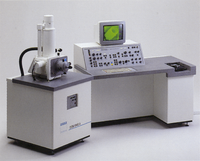
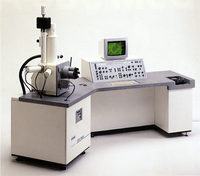
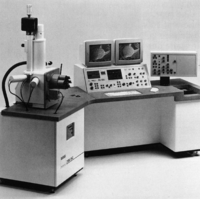
Zeiss produced and continues to produce SEM as well, where they introduced the Electrostatic Electromagnetic GEMINI Column with the DSM982. Further more Zeiss produces optics, light microscopes, and much much more. (add more later)


The EM9 marked the first all Electromagnetic Electron Microscope constructed by Carl Zeiss.

Transmition Electron Microscopes


General
Year 1947
Successor EM8
Mag. Range 1500x, 5000x, 15000x
Electron Source
Acellerating Voltage 60 KV (50 KV)
Objective
Lens Type Electrostatic
Resolution 20Å
Projective Lens
Lens Type Electrostatic
No. of Lenses 2


General
Year 1948
Successor EM9
Mag. Range 900x, 1.6Kx, 3Kx, 5Kx, 9Kx, 16Kx
Electron Source
Accelerator Type Steigerwald remote focus Triode
Acellerating Voltage 60 KV
Cathode Tungsten Hairpin
Objective
Lens Type Electrostatic
Stigmator Electrostatic Hexapol
Resolution 7-9Å
Projective Lens
Lens Type Electrostatic
No. of Lenses 3


General
Successor EM10
Mag. Range 1800x, 8000x, 26Kx, 60Kx, 0-60Kx
Mag. Gauge Text and Bulb
Power Requirment 1.8 KVA
System Weight 1320 lbs
Electron Source
Accelerator Type Self Biased Triode
Acellerating Voltage 60 KV
Cathode Tungsten Hairpin
Condenser
Lens Type Electromagnetic
Nu. of Lenses 1
Stage
Holder Type Side Entry
Objective
Lens Type Electromagnetic
Focal Length 4mm
Stigmator Electrostatic Octopol
Resolution 7-9Å
Projective Lens
Lens Type Electromagnetic
No. of Lenses 2
Configuration Single Polpiece


General
Successor EM10A
Mag. Range 100x, 1000x - 200Kx
Mag. Gauge 7-Seg. Digital
Chamber Pressure 5*10⁻⁵ Torr
Power Requirment 3.5 KVA
System Weight 800 Kg
Electron Source
Accelerator Type Self Biased Triode
Acellerating Voltage 20, 40, 60, 80, 100 KV
Stability 2*10⁻⁶min
Cathode Tungsten Hairpin
Cathode Heating DC
Condenser
Lens Type Electromagnetic
Nu. of Lenses 2
Stability 5*10⁻⁶/min
Stigmator Quadropol
Spot Size 1 µm
Stage
Holder Type Cartridge, Top Entery
Objective
Lens Type Electromagnetic
Focal Length 2.6mm
Stability 2*10⁻⁶/min
Stigmator Octopol
Spherical Error 2.2 mm
Chromatic Error 1.7 mm
Resolution
Projective Lens
Lens Type Electromagnetic
No. of Lenses 2
Stability 2*10⁻⁶/min
Configuration Single Polpiece
Stigmator Octopol


General
Successor EM10C
Mag. Range 100x, 1000x - 200Kx
Mag. Gauge 7-Seg. Digital
Chamber Pressure 5*10⁻⁵ Torr
Power Requirment 3.5 KVA
System Weight 800 Kg
Electron Source
Accelerator Type Self Biased Triode
Acellerating Voltage 20, 40, 60, 80, 100 KV
Stability 2*10⁻⁶min
Cathode Tungsten Hairpin
Cathode Heating DC
Condenser
Lens Type Electromagnetic
Nu. of Lenses 2
Stability 5*10⁻⁶/min
Stigmator Quadropol
Spot Size 1 µm
Stage
Holder Type Cartridge, Top Entery
Objective
Lens Type Electromagnetic
Focal Length 2.6mm
Stability 2*10⁻⁶/min
Stigmator Octopol
Spherical Error 2.2 mm
Chromatic Error 1.7 mm
Resolution
Projective Lens
Lens Type Electromagnetic
No. of Lenses 2
Stability 2*10⁻⁶/min
Configuration Single Polpiece
Stigmator Octopol


General
Successor EM10CR
Mag. Range 100x, 1000x - 500Kx
Mag. Gauge 7-Seg. Digital
Chamber Pressure 5*10⁻⁵ Torr
Power Requirment 3.5 KVA
System Weight 800 Kg
Electron Source
Accelerator Type Self Biased Triode
Acellerating Voltage 20, 40, 60, 80, 100 KV
Stability 2*10⁻⁶min
Cathode Tungsten Hairpin
Cathode Heating DC
Condenser
Lens Type Electromagnetic
Nu. of Lenses 2
Stability 5*10⁻⁶/min
Stigmator Quadropol
Spot Size 200 nm
Stage
Holder Type Cartridge, Top Entery
Objective
Lens Type Electromagnetic
Focal Length 2.6mm
Stability 2*10⁻⁶/min
Stigmator Octopol
Spherical Error 2.2 mm
Chromatic Error 1.7 mm
Resolution
Projective Lens
Lens Type Electromagnetic
No. of Lenses 2
Stability 2*10⁻⁶/min
Configuration Single Polpiece
Stigmator Octopol


General
Successor EM10CR
Mag. Range 100x, 1000x - 500Kx
Mag. Gauge 7-Seg. Digital
Chamber Pressure 5*10⁻⁷ Torr
Power Requirment 3.5 KVA
System Weight 800 Kg
Electron Source
Accelerator Type Self Biased Triode
Acellerating Voltage 20, 40, 60, 80, 100 KV
Stability 2*10⁻⁶min
Cathode Tungsten Hairpin
Cathode Heating DC
Condenser
Lens Type Electromagnetic
Nu. of Lenses 2
Stability 5*10⁻⁶/min
Stigmator Quadropol
Stage
Holder Type Cartridge, Top Entery
Objective
Lens Type Electromagnetic
Focal Length 2.6mm
Stability 2*10⁻⁶/min
Stigmator Octopol
Spherical Error 2.2 mm
Chromatic Error 1.7 mm
Resolution
Projective Lens
Lens Type Electromagnetic
No. of Lenses 2
Stability 2*10⁻⁶/min
Configuration Single Polpiece
Stigmator Octopol


General
Mag. Range 150x, 1100x, 3000x, 20Kx, 30Kx, 250Kx, 400Kx
Mag. Gauge 7-Seg. Digital
Chamber Pressure 2*10⁻⁶ Torr
Electron Source
Accelerator Type Self Biased Triode
Acellerating Voltage 50, 80 KV
Stability 8*10⁻⁶min
Cathode Tungsten Hairpin
Cathode Heating DC
Condenser
Lens Type Electromagnetic
Nu. of Lenses 2
Stability 6*10⁻⁶/min
Stigmator Quadropol
Spot Size 3 µm
Stage
Holder Type Cartridge, Top Entery
Objective
Lens Type Electromagnetic
Focal Length 2.6mm
Stability 4*10⁻⁶/min
Stigmator Octopol
Spherical Error 2.2 mm
Chromatic Error 1.7 mm
Resolution
Projective Lens
Lens Type Electromagnetic
No. of Lenses 3
Stability 6*10⁻⁶/min
Configuration Single Polpiece
Stigmator Octopol


Electron Source
Accelerator Type Self Biased Triode
Cathode Tungsten Hairpin
Condenser
Lens Type Electromagnetic
Objective
Lens Type Electromagnetic
Projective Lens
Lens Type Electromagnetic


Electron Source
Accelerator Type Self Biased Triode
Cathode Tungsten Hairpin
Condenser
Lens Type Electromagnetic
Objective
Lens Type Electromagnetic
Projective Lens
Lens Type Electromagnetic


Electron Source
Accelerator Type Self Biased Triode
Cathode Tungsten Hairpin
Condenser
Lens Type Electromagnetic
Objective
Lens Type Electromagnetic
Projective Lens
Lens Type Electromagnetic


Electron Source
Accelerator Type Self Biased Triode
Cathode Tungsten Hairpin
Condenser
Lens Type Electromagnetic
Objective
Lens Type Electromagnetic
Projective Lens
Lens Type Electromagnetic


Electron Source
Accelerator Type Self Biased Triode
Cathode LaB6
Condenser
Lens Type Electromagnetic
Objective
Lens Type Electromagnetic
Projective Lens
Lens Type Electromagnetic


Electron Source
Accelerator Type Self Biased Triode
Cathode LaB6
Condenser
Lens Type Electromagnetic
Objective
Lens Type Electromagnetic
Projective Lens
Lens Type Electromagnetic


Electron Source
Accelerator Type Self Biased Triode
Cathode LaB6
Condenser
Lens Type Electromagnetic
Objective
Lens Type Electromagnetic
Projective Lens
Lens Type Electromagnetic


Electron Source
Accelerator Type Self Biased Triode
Cathode LaB6
Condenser
Lens Type Electromagnetic
Objective
Lens Type Electromagnetic
Projective Lens
Lens Type Electromagnetic


Electron Source
Accelerator Type Self Biased Triode
Cathode LaB6/Tungsten Hairpin
Condenser
Lens Type Electromagnetic
Objective
Lens Type Electromagnetic
Projective Lens
Lens Type Electromagnetic


Electron Source
Acellerating Voltage 200 KV
Cathode Schottky Field Emission
Condenser
Lens Type Electromagnetic
Objective
Lens Type Electromagnetic
Projective Lens
Lens Type Electromagnetic


General
Year 2007
Electron Source
Acellerating Voltage 100 KV
Cathode Tungsten Hairpin
Condenser
Lens Type Electromagnetic
Objective
Lens Type Electromagnetic
Resolution
Projective Lens
Lens Type Electromagnetic


Electron Source
Acellerating Voltage 200 KV
Cathode Schottky Field Emission
Condenser
Lens Type Electromagnetic
Objective
Lens Type Electromagnetic
Resolution 0.8Å
Projective Lens
Lens Type Electromagnetic


Electron Source
Acellerating Voltage 200 KV
Cathode Schottky Field Emission
Condenser
Lens Type Electromagnetic
Objective
Lens Type Electromagnetic
Projective Lens
Lens Type Electromagnetic


this list is incomplete

Scanning Electron Microscope

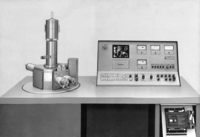
NovaScan 30
Zeiss NovaScan 30.png
General
Year 1974[2]
Successor [[]]
Magnification Range 7X - 150 kX[2]
Magnification Gauge Type
Specemin Chamber Pressure
Power Consumption 3 kVA[2]
System Weight ca. 500 kg[2]
Electrion Source
Accelerator Type Self Biased Triode Gun
Cathode Type Tungsten Hairpin
Accelerating Voltage 1-5 kV, 15 kV, 30 kV[2]
Stability
Cathode Heating Methode
Alignment Methode
Condensor
Number of Condensor Lenses 2[2]
Current Stability
Stigmator
Aperture
Condensor Alignment
Lens Type
Stage
Stage Type
Specimen Loading Column Swingout
Sample Holder Type
X, Y Travel Range 25.4mm[2]
Z Travel Range 38 mm[2]
Tilt Range -5° to +90°[2]
Rotation Range 360°[2]
Drive Mechanism Micrometer (manual)
Objective Lens
Working Distance
Spherical Error
Current Stability
Stigmator dual quadropole[2]
Deflection Type double electromagnetic
Point Resolution 12.5 nm[2]
Lens Type Electromagnetic


DSM-950
Zeiss DSM 950.png
General
Year 1985[3]
Successor [[]]
Magnification Range 15 x- 200 kX[3]
Magnification Gauge Type CRT legend
Specemin Chamber Pressure
Power Consumption 3 kVA[3]
System Weight 400 kg[3]
Electrion Source
Accelerator Type Self Biased Triode Gun [3]
Cathode Type Tungsten Hairpin [3]
Accelerating Voltage 0.5kV - 5 kV, 5 kV - 30 kV[3]
Stability
Cathode Heating Methode DC
Alignment Methode Electromagnetic
Condensor
Number of Condensor Lenses 2[3]
Current Stability
Stigmator
Aperture
Condensor Alignment
Lens Type
Stage
Stage Type
Specimen Loading Pull out Stage
Sample Holder Type
X, Y Travel Range 25 mm[3]
Z Travel Range 25mm [3]
Tilt Range
Rotation Range 360°[3]
Drive Mechanism Knob (manual)
Objective Lens
Working Distance
Spherical Error
Current Stability
Stigmator dual quadropole[3]
Deflection Type double electromagnetic
Point Resolution 5 nm[3], 4 nm poossible[3]
Lens Type Electromagnetic


DSM-940
Zeiss - DSM-940 - from Manual.png
General
Year
Successor DSM 940A
Magnification Range 15 x - 200 kx[4]
Magnification Gauge Type CRT legend[4]
Specemin Chamber Pressure
Power Consumption
System Weight
Electrion Source
Accelerator Type Self Biased Triode Gun
Cathode Type Tungsten Hairpin
Accelerating Voltage 1, 2, 3, 4, 5, 10, 15, 20, 30 kV[4]
Stability
Cathode Heating Methode DC
Alignment Methode Electromagnetic
Condensor
Number of Condensor Lenses 2[4]
Current Stability
Stigmator
Aperture
Condensor Alignment
Lens Type
Stage
Stage Type Eucentric
Specimen Loading Pull out Stage
Sample Holder Type
X, Y Travel Range 25 mm[4]
Z Travel Range 25 mm[4]
Tilt Range -15° to +90°[4]
Rotation Range 360°[4]
Drive Mechanism Knob (manual)
Objective Lens
Working Distance
Spherical Error
Current Stability
Stigmator Double Quadrupole
Deflection Type
Point Resolution 5 nm[4]
Lens Type Electromagnetic


DSM-960
[[File:|200px|link=DSM-960]]
General
Year
Successor DSM-960A
Magnification Range
Magnification Gauge Type CRT legend
Specemin Chamber Pressure
Power Consumption
System Weight
Electrion Source
Accelerator Type Self Biased Triode Gun
Cathode Type Tungsten Hairpin
Accelerating Voltage
Stability
Cathode Heating Methode DC
Alignment Methode Electromagnetic
Condensor
Number of Condensor Lenses 2
Current Stability
Stigmator
Aperture
Condensor Alignment
Lens Type
Stage
Stage Type
Specimen Loading Pull out Stage
Sample Holder Type
X, Y Travel Range
Z Travel Range
Tilt Range
Rotation Range
Drive Mechanism Servo Motor / Knob (manual)
Objective Lens
Working Distance
Spherical Error
Current Stability
Stigmator Double Quadrupole
Deflection Type
Point Resolution
Lens Type Electromagnetic


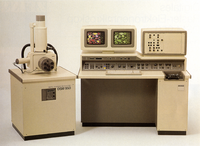
DSM-940A
Zeiss DSM 940A color.png
General
Year 1991[5]
Successor [[]]
Magnification Range
Magnification Gauge Type CRT legend
Specemin Chamber Pressure
Power Consumption
System Weight
Electrion Source
Accelerator Type Self Biased Triode Gun
Cathode Type Tungsten Hairpin
Accelerating Voltage
Stability
Cathode Heating Methode DC
Alignment Methode Electromagnetic
Condensor
Number of Condensor Lenses 2
Current Stability
Stigmator
Aperture
Condensor Alignment
Lens Type
Stage
Stage Type
Specimen Loading Pull out Stage
Sample Holder Type
X, Y Travel Range 25 mm
Z Travel Range 25mm
Tilt Range
Rotation Range 360°
Drive Mechanism Knob (manual)
Objective Lens
Working Distance
Spherical Error
Current Stability
Stigmator dual quadropole
Deflection Type double electromagnetic
Point Resolution
Lens Type Electromagnetic


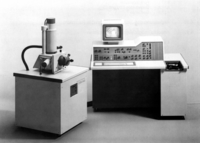
DSM-960A
Zeiss DSM 960A.png
General
Year 1991[6]
Successor [[]]
Magnification Range 4 x - 300 kx[6]
Magnification Gauge Type CRT legend[6]
Specemin Chamber Pressure
Power Consumption
System Weight
Electrion Source
Accelerator Type Self Biased Triode Gun
Cathode Type Tungsten Hairpin / LaB₆[6]
Accelerating Voltage 490 v - 5 kV, 5 kV - 30 kV[6]
Stability
Cathode Heating Methode DC
Alignment Methode Electromagnetic
Condensor
Number of Condensor Lenses 2
Current Stability
Stigmator
Aperture
Condensor Alignment
Lens Type
Stage
Stage Type Eucentric
Specimen Loading Pull out Stage
Sample Holder Type
X, Y Travel Range 80 mm[6]
Z Travel Range 30mm[6]
Tilt Range -15° to +90°[6]
Rotation Range 360°[6]
Drive Mechanism Servo Motor / Knob (manual)
Objective Lens
Working Distance
Spherical Error
Current Stability
Stigmator dual quadropole
Deflection Type double electromagnetic
Point Resolution 4 nm (W) / 3.5nm (LaB₆)[6]
Lens Type Electromagnetic


DSM-962
Zeiss DSM 962.png
General
Year
Successor [[]]
Magnification Range
Magnification Gauge Type CRT legend
Specemin Chamber Pressure
Power Consumption
System Weight
Electrion Source
Accelerator Type Self Biased Triode Gun
Cathode Type Tungsten Hairpin / LaB₆
Accelerating Voltage
Stability
Cathode Heating Methode DC
Alignment Methode Electromagnetic
Condensor
Number of Condensor Lenses 2
Current Stability
Stigmator
Aperture
Condensor Alignment
Lens Type
Stage
Stage Type Eucentric
Specimen Loading Pull out Stage
Sample Holder Type
X, Y Travel Range 80 mm
Z Travel Range 30mm
Tilt Range -15° to +90°
Rotation Range 360°
Drive Mechanism Servo Motor / Knob (manual)
Objective Lens
Working Distance
Spherical Error
Current Stability
Stigmator dual quadropole
Deflection Type double electromagnetic
Point Resolution
Lens Type Electromagnetic


DSM-982 GEMINI
Zeiss - DSM-982 GEMINI - from N25D0080.png
General
Year 1993[7]
Successor LEO 982
Magnification Range up to 700 kx[7]
Magnification Gauge Type CRT legend, Plasma Display
Specemin Chamber Pressure
Power Consumption
System Weight
Electrion Source
Accelerator Type
Cathode Type Schottky FEG[7]
Accelerating Voltage 200 v - 30kV[7]
Stability
Cathode Heating Methode DC
Alignment Methode Electromagnetic / Mechanical
Condensor
Number of Condensor Lenses 1[7]
Current Stability
Stigmator
Aperture
Condensor Alignment
Lens Type
Stage
Stage Type Eucentric
Specimen Loading Pull out Stage[7]
Sample Holder Type
X, Y Travel Range 80 mm[7]
Z Travel Range 30mm[7]
Tilt Range -15° to +90°[7]
Rotation Range 360°[7]
Drive Mechanism Servo Motor / Knob (manual)[7]
Objective Lens
Working Distance
Spherical Error
Current Stability
Stigmator dual quadropole
Deflection Type double electromagnetic
Point Resolution 1.2 mn (20kV)[7], 2.5 nm (5kV)[7], 4nm (1kV)[7]
Lens Type Electromagnetic

Special Projects

Project SATEM / PACEM

The SATEM (Sub Ångström Transmission Electron Mictroscope) was a Libra 200 based machine intended to achieve the highest spacial resolution achievable at the time, it featured a Image Side Spherical Aberation Corrector made by Template:CEOS, and like SESAM, it featured a Pendulum Mount. Later the machine was retrofitted to be a Phase Contrast TEM, and was renamed PACEM

Project SESAM

Main Article: Template:Zeiss SESAM
Project SESAM (Sub Electronvolt Sub Ångström Mictroscope) was a project running from 1996 to 2007 in which the goal was to create a Energy Filtered Electron Microscope ({Electron Energy Loss Spectroscopy | EF-TEM}) capable of having an energy resolution below 1eV while also having very high spacial resolution. (complete description later)

Three machines where built in the project, of which only 1 survived to the current day. The first being based on the EM922 (SESAM 1) and working based on a Corrected Omega Filter with a LaB6 Electron Gun. The second was the archetype for the later Libra-200 series (SESAM II) and featured the same Corrected Omega Filter as the SESAM 1, but used an Electrostatic Omega Filtered Schottky FEG. The third and final machine was the SESAM (SESAM III) featuring the newly developed MANDOLINE Filter, based on a Libra-200, and also featuring a Electrostatic Omega Filtered Schottky FEG. It also featured a Pendulum mounted column within a large frame. Of the three machines, only the SESAM (SESAM III) survived, and is currently stored at the Museum For Electron Microscopy Nuremburg (Germany), where it will soon go on display, and later be usable again.

SESAM I

SESAM I was based on a EM922, and featured a the first Corrected OMEGA Filter. It originally used a LaB6 electron gun, but was later fitted with a Electrostatic Omega monochromated Shottkey Gun. The machine was lost in a fire.

SESAM II

Archetype of the Libra 200, Originally Located at Max Plank Institute for Solid State Physics in Stuttgart Germany, where it later gave way to the SESAM III, based on anecdotes it was moved to the University Tübingen, where it was ultimately scrapped. Its Electron Gun was fitted to the SESAM I.

SESAM (SESAM III)

Originally Located in the Max Plank Institute for Solid State Physics in Stuttgart Germany, it was installed in 2007 and was in operation until 2024 where it suffered a technical defect, after which it was transferred to the Museum.

Project CRISP

Project CRISP (Corrected Illumination Scanning Probe) was a special Libra 200 based machine built in 2007, and was one of the first energy filtered monochromated abberation corrected STEM in the world, it features a Probe side abberation corrector from Template:CEOS as well as a Electrostatic Omega Filtered Shottkey FEG, and a corrected Omega In column Filter.

Project SALVE

Project SALVE (Sub Ångström Low Voltage Electron Microscope) was aimed at creating a TEM for very low voltages observations of Radiation-Sensitive materials at ultra high resolutions, at the university ULM. The project initially was based on the Libra-200 in cooperation between Zeiss and CEOS. The SALVE I was made as a feasibility study [1] started in January 1st 2009 and lasted until December 31st 2010[1]. Based on the original SALVE I column, SALVE II was built, featuring a new Cc/Cs Corrector from CEOS. In January 2013, Zeiss ceased production and development of TEM's[1] and a new cooperation partner was found in FEI, where the SALVE III was then produced

Project KRONOS

Main Article: Template:Zeiss KRONOS
Project KRONOS is a Phase contrast aberration corrected Cryo EM. (add more text later)

Refrences


Documentation

Full list of all documents related to the Zeiss Electron Microscopes.

Transmission Electron Microscope

Scanning Electron Microscopes

Miscilanious

stuff

Transmission Electron Microscops
Model Year Accelerating Voltage Cathode Type Nr. of Condensor Lenses Nr. of Imaging Lenses Projective Resolution Successor
EM7 EM8
EM8 Tungsten Hairpin 1 Electrostatic 3 Electrostatic Imersion and EinzelLense EM9
EM9 60 KV Tungsten Hairpin 1 Electromagnetic 3 Electromagnetic Single Polpiece 70 Å [1] [[EM10}]
EM10 20, 40, 60, 80, 100 KV 2 Electromagnetic 3 Electromagnetic Single Polpiece < 30 Å [2] EM900
EM109 50, 80 KV Tungsten Hairpin 2 Electromagnetic 4 Electromagnetic Single Polpiece 50 Å [3]
EM900 Tungsten Hairpin EM902
EM902 Tungsten Hairpin EM912
EM906 Tungsten Hairpin Single Polpiece
EM910 Tungsten Hairpin
EM912 Tungsten Hairpin

Refrences

  1. Das Elektronenmikroskop TEM+REM, Dr. Rainer Horst Lang, Dr. Jochen Blödorn, 1981, page 131
  2. Das Elektronenmikroskop TEM+REM, Dr. Rainer Horst Lang, Dr. Jochen Blödorn, 1981, page 132
  3. Das Elektronenmikroskop TEM+REM, Dr. Rainer Horst Lang, Dr. Jochen Blödorn, 1981, page 133