Vector recreation of the Zeiss logo as around 1975
Zeiss is a German Manufactuer of Electron Microscopes, much like Siemens it was involved in the invention of the Electron Microsocpe. Originally its development focused on the creation of Electrostatic microscopes, but this approch was later abbandoned in favor of the Electromagnetic lens.
Zeiss Started developing electron microscopes together with AEG, under the engineering leadership of Ernst Brüche, focusing on the creation of Electrostatic Electron Microscopes. This aproch was later abandoned in favor of purely magnetic machines with the EM9, which also marked the departure from the cooperation with AEG. AEG-Zeiss where the first company to introduce the newly invented Stigmator by Otto Rang, first featured in the EM8. This new development allowed much higher resolutions then achieved before, and is now a standard part of every electron microscope.
Zeiss later introduced the first commercial in column Energy filtered TEM with the EM902, featuring a Template:Electron Energy Loss Spectroscopy, then continuing this development with purely magnetic in column filters with the OMEGA, Corrected OMEGA and MANDOLINE Filters. Development and production of TEM's ceased in In January 2013[1].
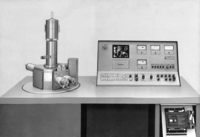
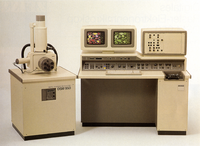
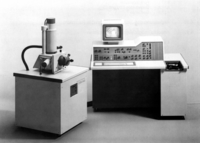
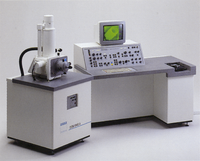
Zeiss produced and continues to produce SEM as well, where they introduced the Electrostatic Electromagnetic GEMINI Column with the DSM982. Further more Zeiss produces optics, light microscopes, and much much more. (add more later)
The EM9 marked the first all Electromagnetic Electron Microscope constructed by Carl Zeiss.
The SATEM (Sub Ångström Transmission Electron Mictroscope) was a Libra 200 based machine intended to achieve the highest spacial resolution achievable at the time, it featured a Image Side Spherical Aberation Corrector made by Template:CEOS, and like SESAM, it featured a Pendulum Mount. Later the machine was retrofitted to be a Phase Contrast TEM, and was renamed PACEM
Project SESAM
Main Article: Template:Zeiss SESAM
Project SESAM (Sub Electronvolt Sub Ångström Mictroscope) was a project running from 1996 to 2007 in which the goal was to create a Energy Filtered Electron Microscope ({Electron Energy Loss Spectroscopy | EF-TEM}) capable of having an energy resolution below 1eV while also having very high spacial resolution. (complete description later)
Three machines where built in the project, of which only 1 survived to the current day. The first being based on the EM922 (SESAM 1) and working based on a Corrected Omega Filter with a LaB6 Electron Gun. The second was the archetype for the later Libra-200 series (SESAM II) and featured the same Corrected Omega Filter as the SESAM 1, but used an Electrostatic Omega Filtered Schottky FEG. The third and final machine was the SESAM (SESAM III) featuring the newly developed MANDOLINE Filter, based on a Libra-200, and also featuring a Electrostatic Omega Filtered Schottky FEG. It also featured a Pendulum mounted column within a large frame.
Of the three machines, only the SESAM (SESAM III) survived, and is currently stored at the Museum For Electron Microscopy Nuremburg (Germany), where it will soon go on display, and later be usable again.
SESAM I
SESAM I was based on a EM922, and featured a the first Corrected OMEGA Filter. It originally used a LaB6 electron gun, but was later fitted with a Electrostatic Omega monochromated Shottkey Gun. The machine was lost in a fire.
SESAM II
Archetype of the Libra 200, Originally Located at Max Plank Institute for Solid State Physics in Stuttgart Germany, where it later gave way to the SESAM III, based on anecdotes it was moved to the University Tübingen, where it was ultimately scrapped. Its Electron Gun was fitted to the SESAM I.
SESAM (SESAM III)
Originally Located in the Max Plank Institute for Solid State Physics in Stuttgart Germany, it was installed in 2007 and was in operation until 2024 where it suffered a technical defect, after which it was transferred to the Museum.
Project CRISP
Project CRISP (Corrected Illumination Scanning Probe) was a special Libra 200 based machine built in 2007, and was one of the first energy filtered monochromated abberation corrected STEM in the world, it features a Probe side abberation corrector from Template:CEOS as well as a Electrostatic Omega Filtered Shottkey FEG, and a corrected Omega In column Filter.
Project SALVE
Project SALVE (Sub Ångström Low Voltage Electron Microscope) was aimed at creating a TEM for very low voltages observations of Radiation-Sensitive materials at ultra high resolutions, at the university ULM. The project initially was based on the Libra-200 in cooperation between Zeiss and CEOS.
The SALVE I was made as a feasibility study [1] started in January 1st 2009 and lasted until December 31st 2010[1]. Based on the original SALVE I column, SALVE II was built, featuring a new Cc/Cs Corrector from CEOS.
In January 2013, Zeiss ceased production and development of TEM's[1] and a new cooperation partner was found in FEI, where the SALVE III was then produced
Project KRONOS
Main Article: Template:Zeiss KRONOS
Project KRONOS is a Phase contrast aberration corrected Cryo EM. (add more text later)